This error message is only visible to WordPress admins
Error: There is no connected account for the user 17841400008388200.
If you’ve been dealing with heel pain, a stubborn tendon injury, or a condition that hasn’t responded to other treatments, shockwave therapy could be exactly what you need.
At Hurst Podiatry, we offer both radial and focused shockwave therapy — two distinct and highly effective forms of this evidence-based treatment. Having access to both technologies means we can choose the right tool for your specific condition, rather than applying a one-size-fits-all approach. No referral is required — book directly and we’ll guide you through everything.
Shockwave therapy (also known as ESWT — Extracorporeal Shockwave Therapy) is a non-invasive treatment that delivers acoustic energy pulses through the skin and into damaged tissue. These pulses reduce pain, stimulate the body’s natural healing response, and help address the underlying processes that keep a chronic injury from resolving on its own.
It is widely used in podiatry and sports medicine, supported by a strong body of clinical research, and is commonly incorporated as part of a broader treatment plan rather than used in isolation.
There are two main forms: radial shockwave and focused shockwave. Both are available at Hurst Podiatry. Read on to understand how each works and which may be right for you.
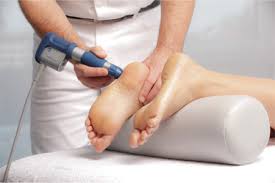
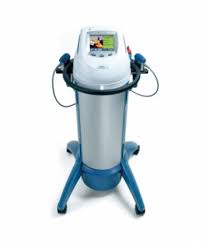
Radial shockwave uses a pneumatic mechanism — a rapidly moving piece of metal inside the handpiece generates pressure pulses that radiate outward from the tip of the device. This means the energy spreads across a wider area, making it well suited to conditions that are more superficial or that affect a broad region of tissue.
It has been used clinically for decades and is one of the most thoroughly researched non-surgical treatments in musculoskeletal podiatry.
Here is how it helps:
Chronic injuries can become “stuck” — the healing process stalls, and rather than recovering, the tissue gradually deteriorates. Radial shockwave creates a controlled level of microtrauma, which the body responds to as a low-level new injury. This triggers the healing cascade to restart and progress again.
The reactivated healing response brings improved blood flow to the treated area. Better circulation delivers the oxygen, growth factors and nutrients the tissue needs to repair and rebuild.
Tendons, fascia and ligaments are predominantly made of collagen fibres. Shockwave stimulates the production of new, healthy collagen — the structural material your body needs to rebuild damaged tissue and restore full strength and function.
Shockwave helps break down Substance P — a peptide responsible for activating the pain receptors (NK1 receptors) that become sensitised in chronic injuries. Reducing Substance P lowers pain levels, even before the tissue has fully healed.
Focused shockwave uses an electromagnetic or piezoelectric mechanism to converge acoustic energy at a precise focal point deep within the tissue — rather than spreading outward from the handpiece. This means the treatment can be directed exactly where the damage is, at the correct depth, with a level of accuracy that radial shockwave cannot match.
Focused ESWT has been used in medicine for decades — originally to break up kidney stones — and its application to musculoskeletal conditions is well supported by clinical research. It is not experimental.
Here is what makes it different:

Energy is focused exactly where it needs to be — at the site of the damage, at the right depth in the tissue. This level of targeting allows us to treat specific pathology more directly, rather than treating a general area and hoping the energy reaches the problem.
Some conditions — including Morton’s neuromas, deep plantar fascia tears and deeper tendon injuries — sit at a depth where radial shockwave cannot deliver effective energy. Focused shockwave can reach these structures and provide meaningful therapeutic benefit right at the source.
Because the energy converges at the focal point rather than spreading broadly, the surrounding healthy tissue is less affected. This makes focused shockwave a more targeted option for complex or sensitive presentations.
If you’ve had radial shockwave elsewhere — or tried other treatments — without achieving full resolution, focused shockwave may be the next step. Its precision and depth of penetration can make a real difference in cases that haven’t responded to previous approaches.
Your podiatrist will make this call based on your assessment. But here is a general guide to how we think about it:
In many cases the decision is straightforward. In others, your podiatrist may recommend one type to begin with and reassess as treatment progresses. You do not need to know which type you need before you book — we will guide you through it at your appointment.
Some of the common conditions our podiatrists use shockwave therapy — radial or focused — to treat include:
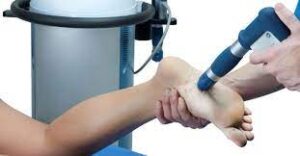
This is not an exhaustive list. If you are not sure whether your condition is suitable, book a consultation and we will let you know whether shockwave therapy is the right approach for you.
Having access to both technologies means we can match the treatment to your condition — not the other way around. Many clinics offer only one type of shockwave therapy. At Hurst Podiatry, your podiatrist has the full toolkit and will use whichever approach gives you the best chance of a successful outcome.
We do not apply a one-size approach. Your assessment determines which modality we use, what settings we apply, and how many sessions are appropriate for your specific condition. You will always understand what we are doing and why — we believe in keeping you informed every step of the way.
Our team has extensive experience delivering shockwave therapy across a wide range of foot and ankle conditions. We stay current with the clinical evidence and continually refine our approach to give our patients the best possible results. When you come to Hurst Podiatry, you are in experienced hands.
Shockwave therapy is $39 per session on top of the price of your consult, regardless of which type is used. We will be upfront about how many sessions we anticipate you will need so you can plan accordingly — and we will reassess your progress as treatment continues.
You can book directly with us. We are available to patients of all ages. If you are in Melbourne’s Eastern suburbs and dealing with a painful foot or ankle condition, we are here to help — and we want to make getting started as easy as possible.
Focused shockwave only available at Kilsyth clinic
Radial shockwave generates pressure pulses that spread outward from the tip of the handpiece, treating a wider and more superficial area of tissue. Focused shockwave converges energy at a precise focal point at a specific depth in the tissue — allowing us to target deeper structures more accurately. Both are clinically effective; the choice depends on your condition, the depth of the pathology, and how your body has responded to previous treatments. Your podiatrist will determine which is most appropriate for you at your assessment.
Some discomfort during the session is normal — and a certain level of intensity is actually important for the treatment to be clinically effective. Most patients describe it as a strong, deep pressure or a dull aching sensation. We use a gradual ramp-up approach so your body can adjust to the treatment, and we can modify the intensity if needed. Any discomfort typically settles quickly after the session. You may notice a bruised feeling in the treated area for a day or two afterwards, which we recommend managing with ice.
This varies depending on the condition, its severity, and how your body responds to treatment. Most patients require between 3 and 6 sessions. Focused shockwave may achieve results in fewer sessions for some presentations. Sessions are typically spaced 5–7 days apart to allow the healing response to progress between treatments. Your podiatrist will give you an individualised estimate at your first appointment and will reassess your progress as treatment continues
This is one of the most common questions we hear, and the answer is often yes — but with a different approach. If you have had radial shockwave elsewhere without a full resolution, focused shockwave may be the right next step. Its ability to target deeper structures and deliver higher energy at the focal point can make a real difference in cases that have not responded to radial treatment. It is also worth reviewing the original diagnosis — persistent injuries sometimes have a contributing factor that was not fully identified or addressed the first time around. We are happy to take a fresh look.
Yes, when delivered by a trained clinician. Like any treatment, there are some contraindications — shockwave is not applied over growth plates in younger patients, directly over a pacemaker, over areas of active infection, malignancy, or open wounds. Your podiatrist will screen you for these before beginning treatment. For most people with musculoskeletal foot and ankle conditions, shockwave therapy is a safe, non-invasive option with a well-established clinical track record.
No. You can book directly with Hurst Podiatry without any referral from your GP or another health professional. We are available to patients of all ages. Call our Kilsyth clinic on (03) 8799 4426 or our Healesville clinic on (03) 5901 2216, or book online using the button below.
Radial shockwave therapy is available across our clinics. Focused shockwave therapy is currently available at our Kilsyth clinic at 2/463 Mt Dandenong Road. Please keep this in mind when selecting your preferred location at the time of booking.
Shockwave therapy — whether radial or focused — is $39 per session. This is in addition to your standard consultation fee. We will let you know at your appointment how many sessions we expect you will need, so you can plan accordingly.
Shockwave therapy can be used for a wide range of foot and ankle conditions, including plantar fasciitis, Achilles tendinopathy, Morton’s neuroma, shin splints, heel spurs, and various tendinopathies. The full conditions list is detailed above on this page. If you are unsure whether your condition is suitable, the best step is to book an assessment — we will give you a clear answer once we have had a proper look.
Focused shockwave technology is not new. It has been used in medicine for decades, originally to break up kidney stones, and later in orthopaedic and sports medicine settings. Its application to musculoskeletal conditions such as tendinopathies, plantar fasciitis and neuromas is supported by a strong and growing body of clinical research, and it is used by podiatrists, physiotherapists and sports medicine physicians worldwide. When we recommend focused shockwave therapy, it is based on evidence and clinical experience — not a new trend.